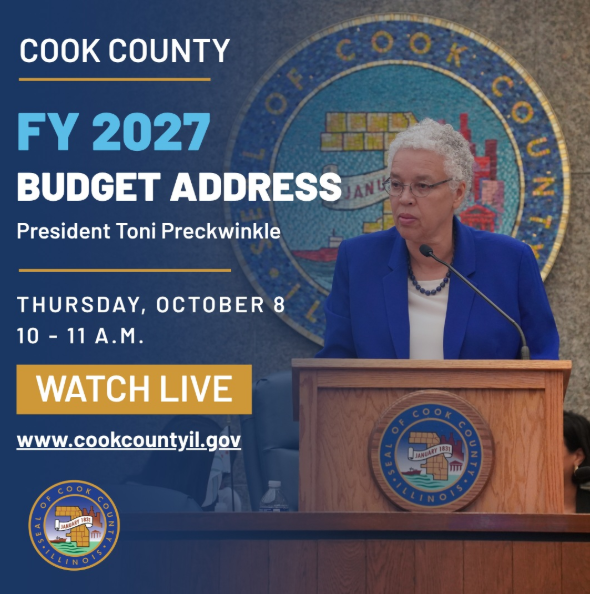
On October 8, 2026, Cook County Board President Toni Preckwinkle presented her proposed $9.69 billion budget for fiscal year 2027.
As with most Cook County Board meetings, the session began with public comments. Several speakers praised Preckwinkle and the Board of Commissioners for their hard work.
One speaker, who goes by “Coach,” thanked Preckwinkle for the Bridge Loan Program. He explained that without the financial assistance, the organization he represented might have been forced to close its doors.
The irony is that Cook County established the program to address delays in property tax distributions. Those delays have left local governments struggling to fund essential services.
While the program provides much-needed temporary relief, it raises a larger question: Why are local institutions being forced to borrow money because Cook County’s property tax system cannot deliver funding on time?
This same question of temporary solutions versus long-term problems carries over into the proposed 2027 budget.
A $550 Million Budget Gap
President Preckwinkle presented a $9.69 billion budget proposal designed to close an approximately $550 million shortfall without raising taxes, laying off employees, or cutting essential services.
During her speech, Preckwinkle pointed to several financial challenges facing Cook County, particularly a transportation funding lawsuit and changes in federal healthcare funding.
Michael Murphy, the Libertarian candidate for Cook County Board President, questioned whether these financial problems should have come as a surprise.
“The financial challenges Cook County faces today should not come as a surprise to anyone. Once again, we are looking for easy answers to solve short-term budget problems,” Murphy stated.
While the proposed budget addresses the immediate shortfall, the question remains whether Cook County is adequately preparing for the financial challenges ahead.
The Transportation Funding Lawsuit
One of the largest financial challenges facing Cook County stems from the Illinois Road and Transportation Builders Association lawsuit.
The lawsuit challenged Cook County’s use of revenue collected through transportation-related taxes, including gasoline taxes, vehicle taxes, and parking garage taxes.
For years, portions of this revenue were used to support other county government functions, including public safety and court-related operations.
Illinois voters approved a constitutional amendment in 2016 restricting transportation-related revenue to transportation purposes.
In January 2026, a Cook County circuit court ruled against the county over its use of transportation revenue. The county is appealing that decision.
The ruling restricts approximately $258 million in revenue previously available for county operations, contributing significantly to the 2027 budget gap.
Although the court ruling created an immediate financial challenge, the restrictions themselves were approved by voters a decade earlier.
This raises questions about the county’s long-term financial planning and its continued reliance on revenue that was subject to constitutional restrictions.
Federal Healthcare Funding and CountyCare
Another major challenge highlighted by Preckwinkle was the passage of H.R. 1, commonly known as the One Big Beautiful Bill Act.
The legislation changed federal Medicaid eligibility and funding rules, creating additional financial pressure for Cook County Health.
Cook County operates CountyCare, a Medicaid managed care program established through provisions of the Affordable Care Act, commonly known as Obamacare. CountyCare began enrolling residents in 2013, ahead of broader Medicaid expansion in 2014.
From its beginning, the Affordable Care Act faced significant political opposition, including repeated efforts by Republican lawmakers to repeal or substantially change the legislation.
Nevertheless, CountyCare became an important part of Cook County’s healthcare system and financial structure.
The county now anticipates declining CountyCare enrollment and revenue as federal Medicaid changes take effect. These changes create genuine financial challenges, particularly for residents who depend on Cook County Health for medical services.
While significant federal funding cuts create serious challenges for agencies that depend on those dollars, they also highlight the importance of long-term financial planning.
Local governments cannot control every decision made in Washington. However, they remain responsible for preparing their operations for changes in federal funding.
If We Can Reduce Spending Now, Why Not Before?
Throughout her presentation, Preckwinkle emphasized her administration’s record of fiscal responsibility.
The county pointed to stronger reserves, improved credit ratings, pension funding improvements, and efforts to manage spending.
However, the proposed budget also identifies significant opportunities to reduce costs.
Cook County reports approximately $35 million in departmental spending reductions and $46 million in savings through tighter vacancy management. Cook County Health has also reduced spending through operational improvements and changes in how services are delivered.
These actions help address the immediate budget gap while preserving essential services.
But they also raise an important question: If Cook County can identify savings without cutting essential services today, could some of those savings have been achieved sooner?
Finding efficiencies should not be something government does only when facing a financial crisis.
Taxpayers deserve an ongoing commitment to responsible spending, even during years when revenues exceed expectations.
Using Money Intended for 2028 and Beyond
Perhaps the most concerning part of the proposed 2027 budget is its reliance on funds previously designated for future programs.
Cook County received federal funding through the American Rescue Plan Act (ARPA), commonly known as COVID-19 relief funding.
The county previously set aside portions of its funding to help sustain programs after the original federal relief money was exhausted.
Under the proposed budget, approximately $61.2 million previously committed to ARPA program sustainability in fiscal year 2028 and beyond will instead support general county operations. Another $52.6 million is allocated to ARPA-related programs in 2027.
The money is available for the county to reallocate, but the decision raises questions about the future of programs that were expected to receive continued support.
What happens when those programs need funding in 2028?
Will Cook County reduce or eliminate programs, identify alternative funding, or ask taxpayers to contribute more?
The proposed budget may provide temporary financial relief, but the challenge of sustaining these programs remains.
As Murphy stated, “At the end of the day, we need to have the conversation no one wants to have. Cook County is getting smaller. We are losing population, and eventually, no matter how much ‘good government’ we practice, we will face difficult decisions. We will either need to reduce services or raise taxes on the residents who remain.”
Addressing the Causes, Not Just the Symptoms
Murphy also raised concerns about whether government spending is addressing the underlying problems facing Cook County.
“A significant amount of Cook County’s spending goes toward programs that address the symptoms of our problems rather than their underlying causes,” Murphy said.
“For example, we help fund the construction of new homes, but many residents still cannot afford to purchase them. So, we introduce down payment assistance programs to help people become homeowners.
Once those residents move into their homes, they face another challenge: rising property taxes. Local governments continue increasing their property tax levies, making homeownership even more expensive.
We are creating a cycle where government provides financial assistance to help residents afford their homes, only for rising costs and taxes to make those same homes increasingly unaffordable.
At some point, we need to stop asking how much more money government can spend and start asking why these problems continue to exist in the first place.”
This concern extends beyond housing.
Programs that provide temporary financial assistance can offer meaningful relief. However, long-term affordability also depends on housing supply, employment opportunities, local taxation, and the overall cost of living.
For Cook County, these challenges are particularly important as the county continues confronting population loss.
A smaller population can place additional pressure on public finances when the cost of maintaining government services does not decline at the same rate.
What Happens in 2028?
Cook County’s proposed 2027 budget avoids immediate tax increases and protects essential services. Those are important outcomes for residents already struggling with the rising cost of living.
However, the budget also relies partly on one-time resources and reallocates funding previously intended for future programs.
The administration deserves recognition for improvements in reserves, credit ratings, and pension funding. At the same time, those accomplishments do not eliminate concerns about recurring expenses and the future availability of revenue.
The broader question is whether Cook County can sustain its operations without repeatedly relying on temporary financial solutions.
Cook County residents deserve more than a balanced budget for a single year. They deserve a long-term financial plan that acknowledges population decline, addresses the causes of rising costs, and explains how essential services will be funded in the years ahead.
Balancing the 2027 budget is one challenge. Preparing for 2028 and beyond is another.
Lastly, Michael Murphy urges the Cook County Board of Commissioners, many of whom faced little or no opposition in their elections, to make the difficult financial decisions now rather than postpone them.
“The longer we delay these decisions, the more difficult and painful they become. We need the Board of Commissioners to make the hard choices today so residents are not left facing even greater financial challenges in 2028 and beyond,” Murphy stated.